
You are your own best advocate.
Get the screening you need.
Do you have dense breasts?
Your healthcare provider may not be up-to-date on the risks of dense breasts. You are. Here's how to have a conversation with your provider.
You know that women with dense breasts face a higher risk of cancer and that cancer can be missed on mammogram because both dense tissue and cancer appear white.
You know that a mammogram is not enough for you. Additional screening with ultrasound or MRI can find cancers missed on mammogram. You will need a requisition for additional screening and you will have to advocate for yourself to get that requisition. In Ontario, referrals to hospitals may be rejected, but if you get the physical requisition in your hand, you can call a community clinic (neighbourhood imaging clinic) to book a screening ultrasound on your own.
In some provinces, supplemental screening is not accessible. However, that does not mean you should not ask for it- we must continue asking if we want change.
A list of clinics across the country that we are aware of that offer supplemental screening can be found here
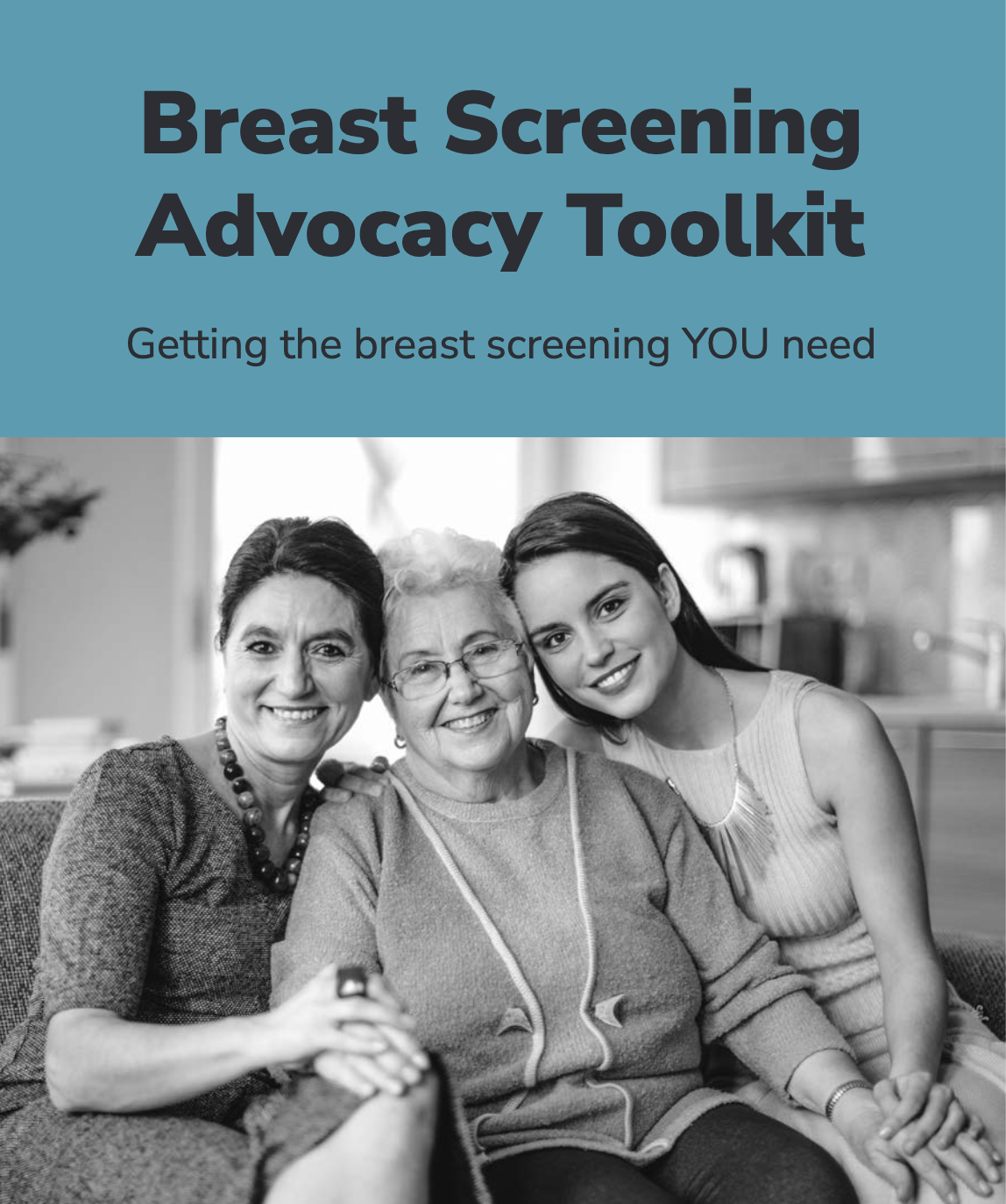
We outline conversation tips for your discussion with your healthcare provider in our Advocacy Tool Kit.
Are you in your 40s?
Your healthcare provider may not be aware that the decision to screen at 40 is a woman's decision based on her values and preferences. Yes, it is your choice.
No woman in Canada should be denied a requisition. If you live in a province where you cannot self-refer at 40, it is your decision to have a mammogram in your 40s. That's also what the breast screening guidelines state. Your choice. It is highly recommended by experts to do so since 17% of breast cancers happen in the 40s and these cancers are more fuelled by hormones and thus more aggressive.
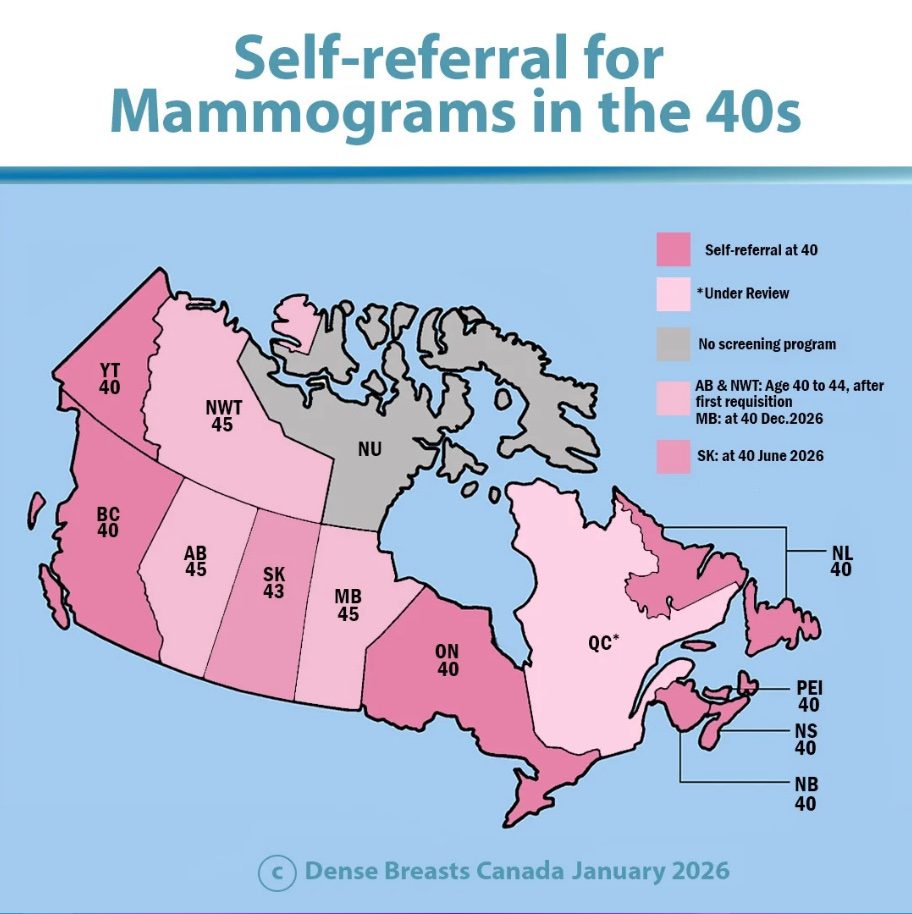
If you live in a province where you still need a requisition at 40 (AB, SK, QC, MB, NWT) then please check out the conversation tips for speaking with your health care provider about a mammogram starting at 40 in our Advocacy Toolkit.
Are you in your 20s or 30s?
Since most jurisdictions in Canada only allow self-referral for breast screening starting at 40 or 45, what can you do to be proactive about your breast health in your 20s and 30s?
1. Know your risk factors. Discuss your risk with your family doctor between ages 25-30.
According to the Canadian Society of Breast Imaging, a woman’s risk for getting breast cancer should be assessed by her health care provider by age 25-30 to determine if early screening is appropriate. About 4% of invasive breast cancers were diagnosed in women in Canada under age 40 in 2019.
Do you have personal risk for breast cancer, such as family history of breast cancer? If you have a first degree relative who had breast cancer in the 40s, it may be recommended that you begin screening ten years earlier. If you have a family history of genetic mutations, or history of lymphoma, you may be eligible for a provincial high risk program in which screening would begin earlier. There are many different risk scenarios so please have a discussion with you provider since women with a higher risk may need to start screening earlier than 40. Consider completing the IBIS risk calculator with your physician and discuss if there is a need for a personalized screening plan.
2. Be breast aware: Regularly perform self-exams to become familiar with how your breasts normally look and feel. Check out www.knowyourlemons.com for examples of breast cancer symptoms and clear instructions on how to perform a breast self-exam. See your health care provider about any unusual changes to your breasts. Insist on imaging for any symptom of breast cancer.
3. Make healthy lifestyle choices: Maintain a healthy lifestyle by staying active and eating a balanced diet. Avoid alcohol and smoking, which are both carcinogenic. These steps can reduce your overall cancer risk. It is estimated that ~50% of breast cancers can be prevented.
4. Advocate for yourself: Self-advocacy is important in this age group. If your circumstances/history indicate you need screening before 40, advocate for yourself. If you have a symptom, you may hear you are too young for it to be breast cancer. Only imaging can determine if the symptom is of concern. Do not be dismissed. Seek care elsewhere if needed. No healthcare provider has X-ray vision. You are your own best advocate.
Conversation tips for a discussion with your healthcare provider.
You’re in your 40s and denied a mammogram.
You have dense breasts and are denied a screening ultrasound.
You can refer your doctor/nurse practitioner to the Health Professionals tab on densebreast-info.org
Print and take to your doctor these recommendations from Canada's breast cancer screening experts at the Canadian Association of Radiologists and the Canadian Society of Breast Imaging.
Current breast screening recommendations for average risk women from the Canadian Association of Radiologists and Canadian Society of Breast Imaging are summarized as follows:
1. Women aged 40-49 should screen ANNUALLY with mammography
2. Women aged 50-74 should screen every one to two years with mammography
3. Women OVER aged 74 should screen every one to two years with mammography for as long as they are in good general health with life expectancy of approximately 7 years or greater
4. Below age 40 screening is not recommended for average risk women, but risk should be assessed by age 25-30 in order to determine if early screening is appropriate.

Spread the word.
Tell other women about dense breasts. Tell other women about the importance of mammograms.
Ask friends, family and colleagues if they are looking after their breast health. Do they know their density? If not, tell them why it’s important to know it. Have they scheduled their routine mammogram? Remind them of the importance of early detection. Each one tell one.
Do you know women in their 40s? Please encourage them to start mammograms. Anyone in Canada can have a mammogram in their 40s. In 8 provinces, self-referral at 40 is available (BC, NL, NS, PEI, NB, YT, ON and SK). Cancer in the 40s can be more aggressive. Details on the importance of starting mammograms at 40 can be found in our Advocacy Tool Kit.
Do you know women 74+, please encourage them to continue screening. In 6 provinces, women can self-refer past 74 (BC, MB, SK, NL, YT, NS). In the others, a requisition is needed.
Share your story on our website.
Every breast cancer story is unique and we can learn from each one. Stories are empowering and impactful for others. Please email us: info@densebreastScanada.ca OR upload your story here.
Join our team.
We are looking for help to raise awareness and advocate for better screening in every province. We are also looking for volunteers with expertise in marketing, communication, government relations and social media.
Follow & Share
Please follow us on Facebook, Twitter and Instagram and share our posts.
Demand action.
Advocacy in action.
Density Notification: We have made great progress in Canada on breast density notification coast to coast. In NL, QC, BC, and SK, your density category is online in your health portal. Elsewhere, your breast density category is mailed with your result letter after your screening mammogram.
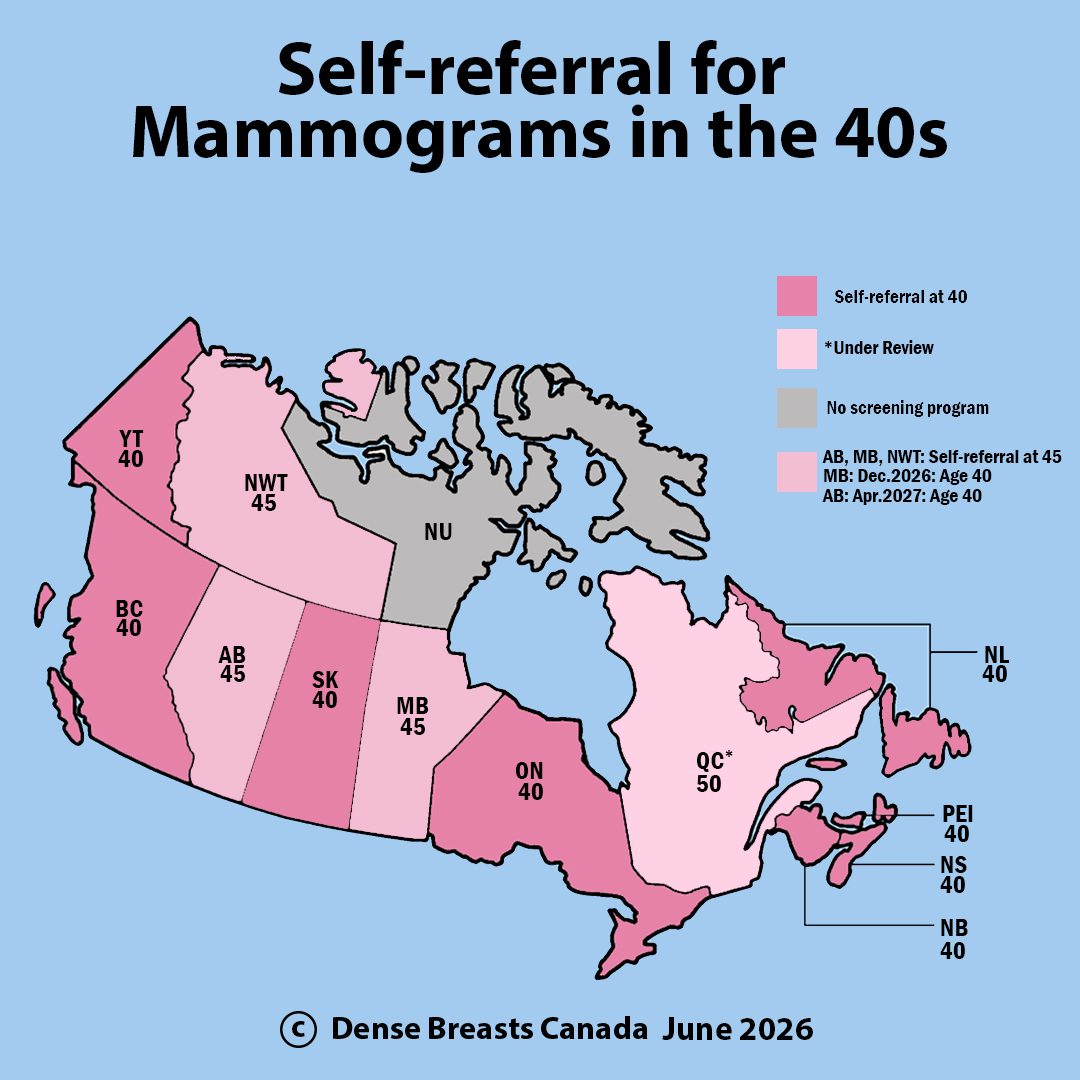
Screening at 40: We have also made great progress on screening, starting at 40. Eight provinces/territories allow women to self-refer at 40 already (BC, ON, NB, NL, NS, NB, YT, SK). MB, AB and NWT begin at 45. MB will lower the age to 40 in December 2026, and AB will lower it in April 2027.
How does your province rate on the 7 optimal breast screening practices? Check out our latest report, Comparing breast screening practices across the country.
Letters to politicians.
Please see the footer for the advocacy letter for your province and please take a minute to send it in. Please consider sharing the letter with your contacts. The more letters that get sent in, the more impactful. Your Health Minister's address is listed below.
Advocacy continues to ensure that women in Canada with dense breasts can access supplemental screening.
Canadian Breast Screening Guidelines 2024.
Our advocacy helped lead to the suspension of the Canadian Task Force on Preventive Health Care. The new National Advisory Committee on Preventive Health Services is expected to prioritize updating the draft 2024 breast screening guidelines. In the interim, guidelines from the Canadian Society of Breast Imaging should be used.
British Columbia: The Honourable Josie Osborne HLTH.Minister@gov.bc.ca
Alberta: The Honourable Adriana LaGrange
Health.minister@gov.ab.ca
Saskatchewan: The Honourable Jeremy Cockrill
He.minister@gov.sk.ca
Manitoba: The Honourable Uzoma Asagwara
minhsltc@manitoba.ca
Ontario: The Honourable Sylvia Jones
sylvia.jones@ontario.ca
Québec:
ministre@msss.gouv.qc.ca
Nova Scotia: The Honourable Michelle Thompson
Health.minister@novascotia.ca
New Brunswick: The Honourable John Dornan
Prince Edward Island: The Honourable Cory Deagle
cdeagleministerhw@gov.pe.ca
NWT: The Honourable Lesa Semmler
Newfoundland: The Honourable Lela Evans
hcsminister@gov.nl.ca
Yukon: The Honourable Brad Cathers
FEDERAL HEALTH MINISTER:
The Honourable Marjorie Michel
hcminister.ministresc@hc-sc.gc.ca
Advocacy Milestones and Impactful Changes
Since its founding in 2016, Dense Breasts Canada (DBC) has emerged as a leading advocate for improved breast cancer screening policies and public awareness across the country. Through tireless efforts, DBC has made significant strides in achieving policy changes that prioritize early detection and equitable access to screening for all women.
You can read about the latest policy changes below, as well as in our report:
Advancing Breast Cancer Screening in Canada: A Summary of Policy Wins and Progress
Breast Density Notification
Screening Age Lowered to 40
When DBC began, only four provinces/ territories (BC, NS, PEI, YT) were allowing women to self-refer for mammograms at age 40. DBC successfully advocated, alongside medical professionals and patient advocates, and now eight provinces/territories allow self-referral at 40 (BC, NS, PEI, YT, NB, ON, NL, SK). MB will be at 40 in Dec 2026. AB will lower the age to 40 in April 2027. We are now only waiting on NWT and QC.
Supplemental Screening for Women with Dense Breasts
Before DBC launched, supplemental screening for women with dense breasts was not widely available. Through DBC’s advocacy, women with dense breasts in BC, AB, NWT, SK, and ON now have access to additional screening. A list of clinics offering supplemental screening is available on our blog page.
Advocating for Better Preventive Health Guidelines
DBC played a leading role in advocating for reform of Canada’s preventive health guideline development process. Through parliamentary committee testimony, meetings with the Public Health Agency of Canada, and sustained advocacy, DBC raised concerns about governance, transparency, evidence review, and the lack of expert and patient involvement in breast screening guideline development.
In March 2025, the federal government suspended the work of the Canadian Task Force on Preventive Health Care and launched a comprehensive review. On June 10, 2026, the Task Force was officially replaced by the National Advisory Committee on Preventive Health Services, a new body designed to strengthen the development of preventive health guidance in Canada through greater transparency, accountability, expertise, and patient engagement.
Raising Awareness
In addition to policy changes, DBC has made significant strides in raising public awareness about the importance of breast cancer screening. Through public education campaigns, social media outreach, and collaborations with medical experts, DBC has empowered women with the knowledge they need to take control of their health.
Public Support and Grassroots Mobilization
DBC has galvanized public support for better screening policies. Through its messaging and community engagement, DBC has amplified the voices of women across Canada who are advocating for better breast screening.